
Figure 1:Overview of the MET-SVGD framework.
End-to-End SVGD Parameter Learning via Reverse KL Minimization
While SVGD particles reliably concentrate in high-density regions of the target distribution for different choices of the kernel bandwidth , entropy estimation via the closed-form SVGD-induced density is considerably more sensitive to this parameter. Specifically, the resulting estimate converges to the true entropy only for a subset of bandwidth values.
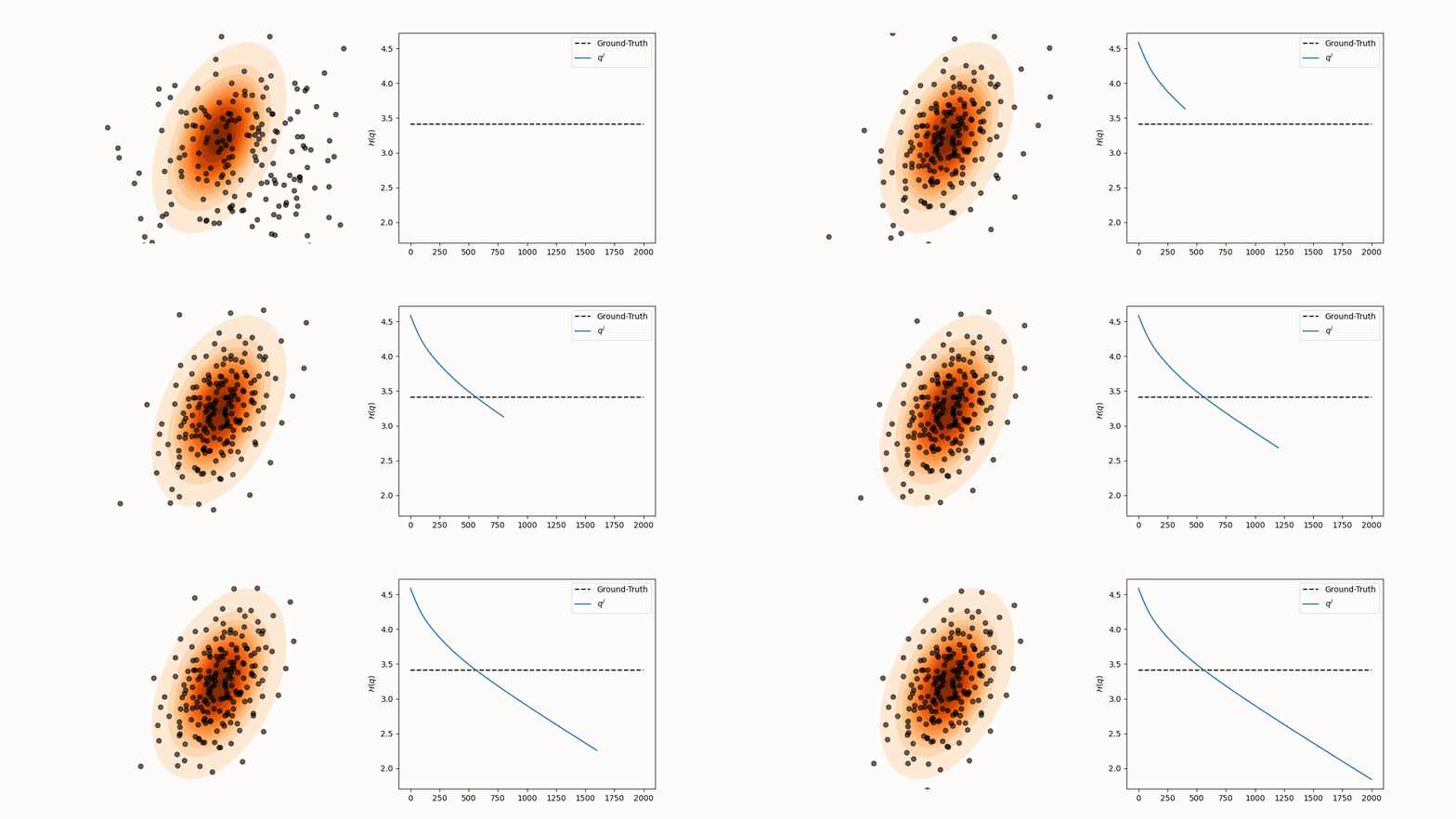
(a)Particle and entropy evolution with .
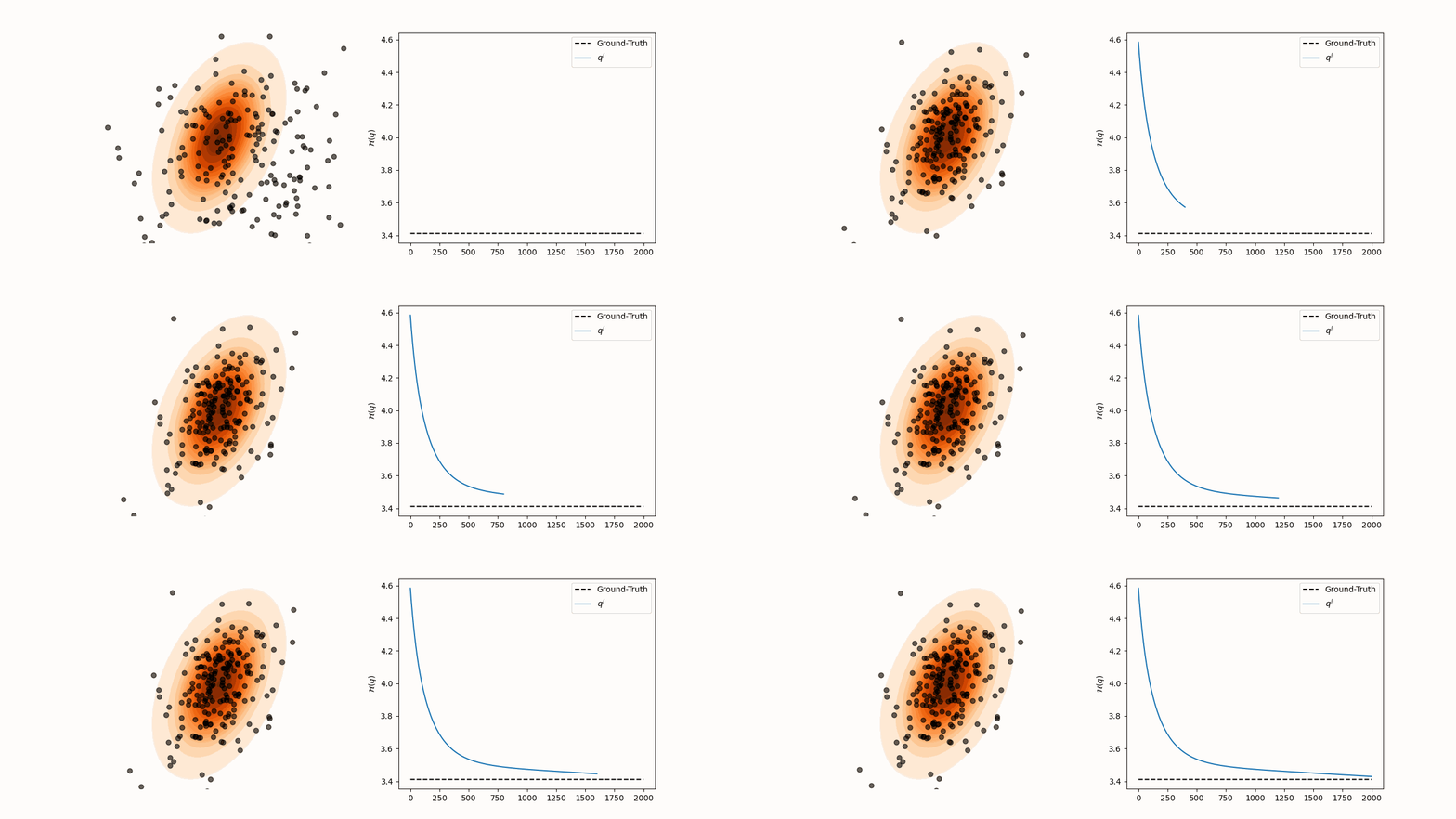
(b)Particle and entropy evolution with .
Figure 2:Particle and entropy evolution for different values. The convergence of the entropy estimate to the true value depends on the choice of despite particles’ convergence to the target.
Code for Figure 2.
from svgd.sampler import SVGD
from svgd.distributions import TorchDistribution, Gaussian
from svgd.kernels import RBF
from svgd.kernels.parameters import HeuristicKP, ParameterKP
from svgd.lrs import ParameterLR
from svgd.callbacks import Logger

import torch
from torch.distributions import MultivariateNormal

import matplotlib.pyplot as plt
from matplotlib.animation import FuncAnimation

torch.manual_seed(0)

sigma_choice = "1"

mu_x, mu_y = -0.6871, 0.8010
target_distribution = TorchDistribution(
    MultivariateNormal(
        torch.Tensor([mu_x, mu_y]),
        torch.Tensor([[0.2260, 0.1652], [0.1652, 0.6779]]).mul(5),
    )
)
initial_distribution = Gaussian(torch.zeros(2), torch.ones(2).mul(6).sqrt())
sigma = (
    HeuristicKP("median")
    if sigma_choice == "median"
    else ParameterKP(torch.tensor(float(sigma_choice)))
)
kernel = RBF(sigma)
lr = ParameterLR(torch.tensor(0.1))
logger = Logger(log_x=True, log_log_q=True)
logger.activated = True
svgd = SVGD(
    target_distribution=target_distribution,
    initial_distribution=initial_distribution,
    kernel=kernel,
    lr=lr,
    callbacks=[logger],
)

n_particles = 200
n_steps = 2000
x, _, _ = svgd.sample_with_log_q(n_particles=n_particles, n_steps=n_steps)
x = x.detach()

bound = 5
grid_x = torch.arange(mu_x - bound, mu_x + bound, 0.01)
grid_y = torch.arange(mu_y - bound, mu_y + bound, 0.01)
xg, yg = torch.meshgrid(grid_x, grid_y, indexing="ij")
grid = torch.cat((xg.reshape(-1)[:, None], yg.reshape(-1)[:, None]), dim=-1)
zg = target_distribution.log_prob(grid).exp().view(xg.shape)

fig, ax = plt.subplots(1, 2, figsize=(6.4 * 2, 4.8))

ax[0].pcolormesh(xg, yg, zg, cmap="Oranges")
ax[0].set_xlim(mu_x - bound, mu_x + bound)
ax[0].set_ylim(mu_y - bound, mu_y + bound)
ax[0].set_axis_off()
scatter = ax[0].scatter([], [], color="black", alpha=0.6)
scatter = ax[0].scatter(*x.T, color="black", alpha=0.6)

ax[1].plot(
    [target_distribution.distribution.entropy() for _ in range(n_steps)],
    color="black",
    ls="--",
    label="Ground-Truth",
)
plot = ax[1].plot([-log_q for log_q in logger.log_q], label="$q^l$")[0]
plot.set_xdata([])
plot.set_ydata([])
ax[1].set_ylabel("$\\mathcal{H}(q)$")
ax[1].legend()

x_data = list(range(len(logger.x)))
y_data = [-log_q for log_q in logger.log_q]


def animate(frame):
    scatter.set_offsets(logger.x[min(frame, len(logger.x) - 1)])
    plot.set_xdata(x_data[:frame])
    plot.set_ydata(y_data[:frame])
    return (scatter, plot)


animation = FuncAnimation(
    fig,
    animate,
    list(range(0, n_steps + 20, 20)),
    interval=1000 / 60,
    blit=False,
)
animation.save(f"sensitivity_{sigma_choice}.gif", fps=120)
To resolve this, we minimize the reverse KL divergence between the induced density and the target . Using the closed-form of , we optimize both the kernel bandwidth and step-size at each step . The objective is:
subject to for all with . Learning both and ensures the trace term stabilizes at 0 at convergence.
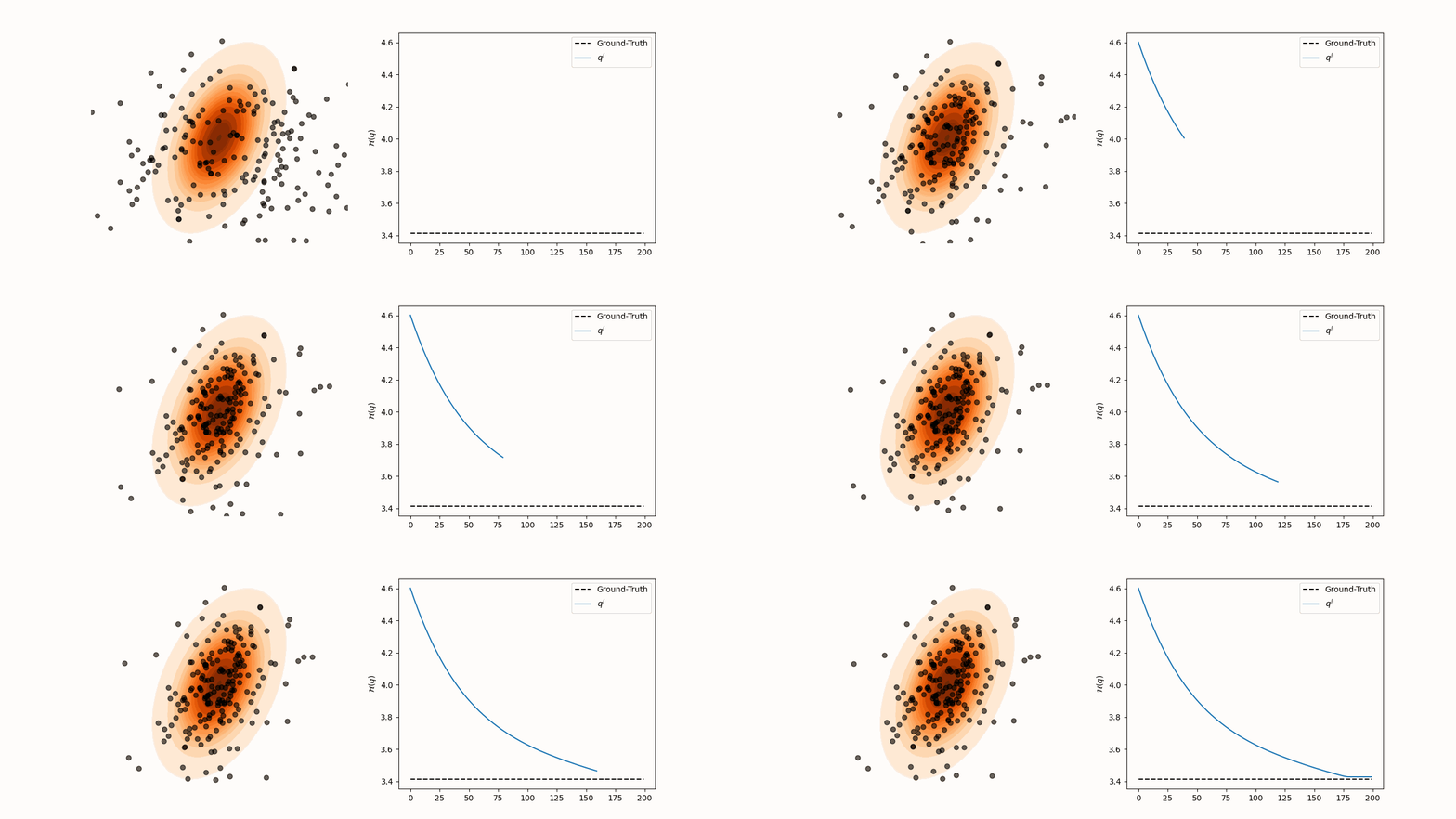
Figure 3:Particle and entropy evolution with learnable kernel bandwidth and step-size.
Code for Figure 3.
from svgd.sampler import SVGD
from svgd.distributions import TorchDistribution, Gaussian
from svgd.kernels import RBF
from svgd.kernels.parameters import StepParameterKP
from svgd.lrs import StepLR
from svgd.callbacks import Logger

import torch
from torch.optim.adam import Adam
from torch.distributions import MultivariateNormal

from tqdm import tqdm
import matplotlib.pyplot as plt
from matplotlib.animation import FuncAnimation

torch.manual_seed(0)

device = "cuda:0"
n_epochs = 100
n_particles = 200
n_steps = 200

mu_x, mu_y = -0.6871, 0.8010
target_distribution = TorchDistribution(
    MultivariateNormal(
        torch.Tensor([mu_x, mu_y]).to(device),
        torch.Tensor([[0.2260, 0.1652], [0.1652, 0.6779]]).mul(5).to(device),
    )
)
initial_distribution = Gaussian(
    torch.zeros(2), torch.ones(2).mul(6).sqrt()
).requires_grad_(False)
sigma = StepParameterKP(torch.zeros(n_steps), lambda x: x.exp())
kernel = RBF(sigma)
lr = StepLR(torch.tensor(0.1), torch.tensor(n_steps - 20), torch.tensor(1e-6))
lr._log_step_size.requires_grad_(False)
lr._log_decay_rate.requires_grad_(False)
logger = Logger(log_x=True, log_log_q=True)
svgd = SVGD(
    target_distribution=target_distribution,
    initial_distribution=initial_distribution,
    kernel=kernel,
    lr=lr,
    bound_lr=True,
    ij_term_density=True,
    callbacks=[logger],
).to(device)
optimizer = Adam(svgd.parameters(), 1e-2)

for epoch in tqdm(range(n_epochs)):
    logger.activated = epoch == n_epochs - 1
    x, _, log_q = svgd.sample_with_log_q(n_particles=n_particles, n_steps=n_steps)
    log_q = log_q.mean()
    log_p = target_distribution.log_prob(x).mean()
    kld = log_q.sub(log_p)
    kld.backward()
    optimizer.step()
    optimizer.zero_grad()

bound = 5
grid_x = torch.arange(mu_x - bound, mu_x + bound, 0.01)
grid_y = torch.arange(mu_y - bound, mu_y + bound, 0.01)
xg, yg = torch.meshgrid(grid_x, grid_y, indexing="ij")
grid = torch.cat((xg.reshape(-1)[:, None], yg.reshape(-1)[:, None]), dim=-1)
zg = target_distribution.log_prob(grid.to(device)).exp().view(xg.shape).cpu()

fig, ax = plt.subplots(1, 2, figsize=(6.4 * 2, 4.8))

ax[0].pcolormesh(xg, yg, zg, cmap="Oranges")
ax[0].set_xlim(mu_x - bound, mu_x + bound)
ax[0].set_ylim(mu_y - bound, mu_y + bound)
ax[0].set_axis_off()
scatter = ax[0].scatter([], [], color="black", alpha=0.6)
scatter = ax[0].scatter(*x.detach().cpu().T, color="black", alpha=0.6)

ax[1].plot(
    [target_distribution.distribution.entropy().item() for _ in range(n_steps)],
    color="black",
    ls="--",
    label="Ground-Truth",
)
plot = ax[1].plot([-log_q for log_q in logger.log_q], label="$q^l$")[0]
plot.set_xdata([])
plot.set_ydata([])
ax[1].set_ylabel("$\\mathcal{H}(q)$")
ax[1].legend()

x_data = list(range(len(logger.x)))
y_data = [-log_q for log_q in logger.log_q]


def animate(frame):
    scatter.set_offsets(logger.x[min(frame, len(logger.x) - 1)])
    plot.set_xdata(x_data[:frame])
    plot.set_ydata(y_data[:frame])
    return (scatter, plot)


animation = FuncAnimation(
    fig,
    animate,
    list(range(0, n_steps + 2, 2)),
    interval=1000 / 60,
    blit=False,
)
animation.save(f"sensitivity_metsvgd.gif", fps=120)
Faster Convergence via Learning the Initial Distribution
To accelerate convergence, MET-SVGD also learns the initial distribution . By capturing the support of the target distribution, reduces the number of required sampling steps. The parameters are optimized jointly with and via reverse KL minimization.
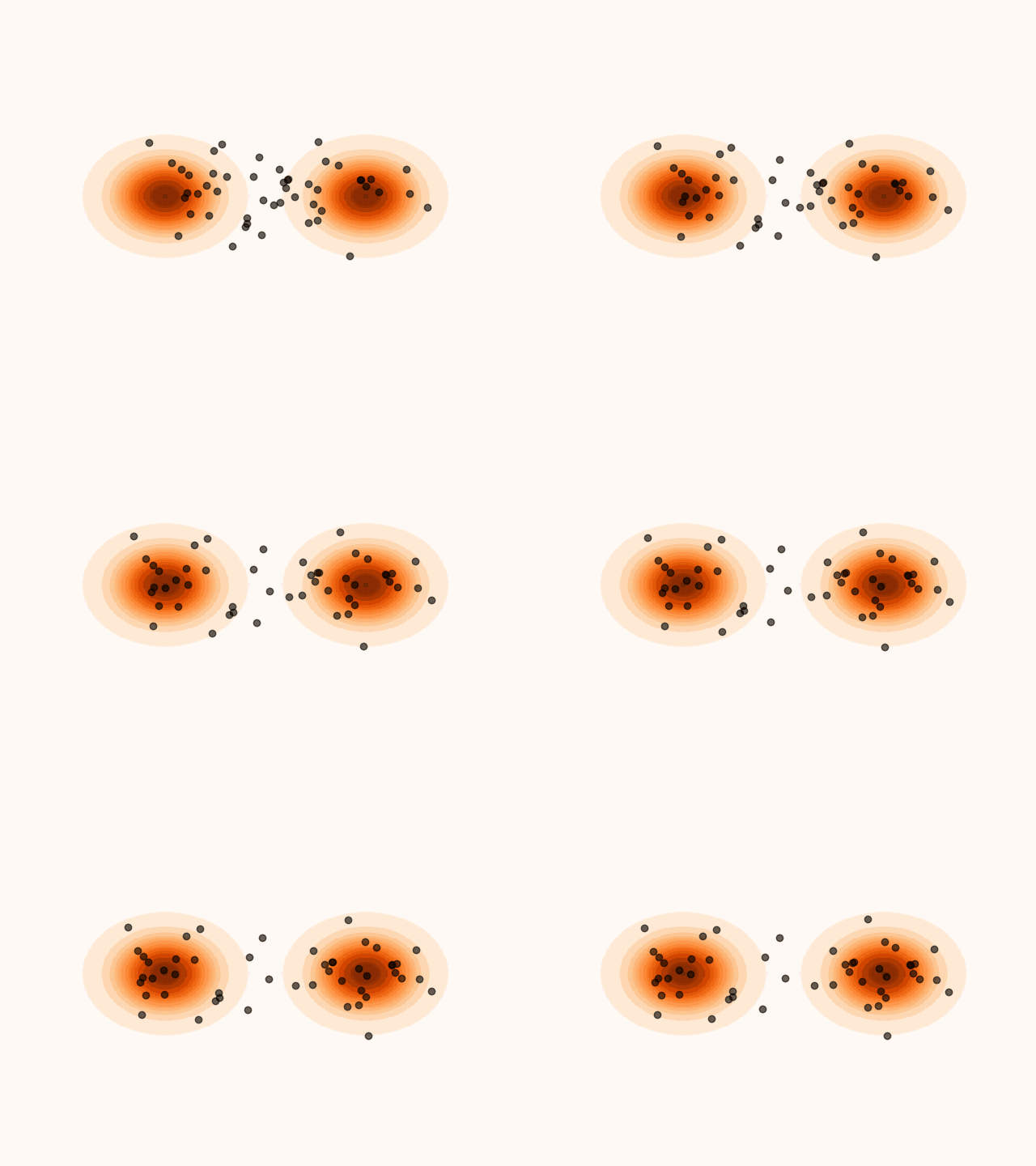
(a)Particle’s evolution with a learned initial distribution.
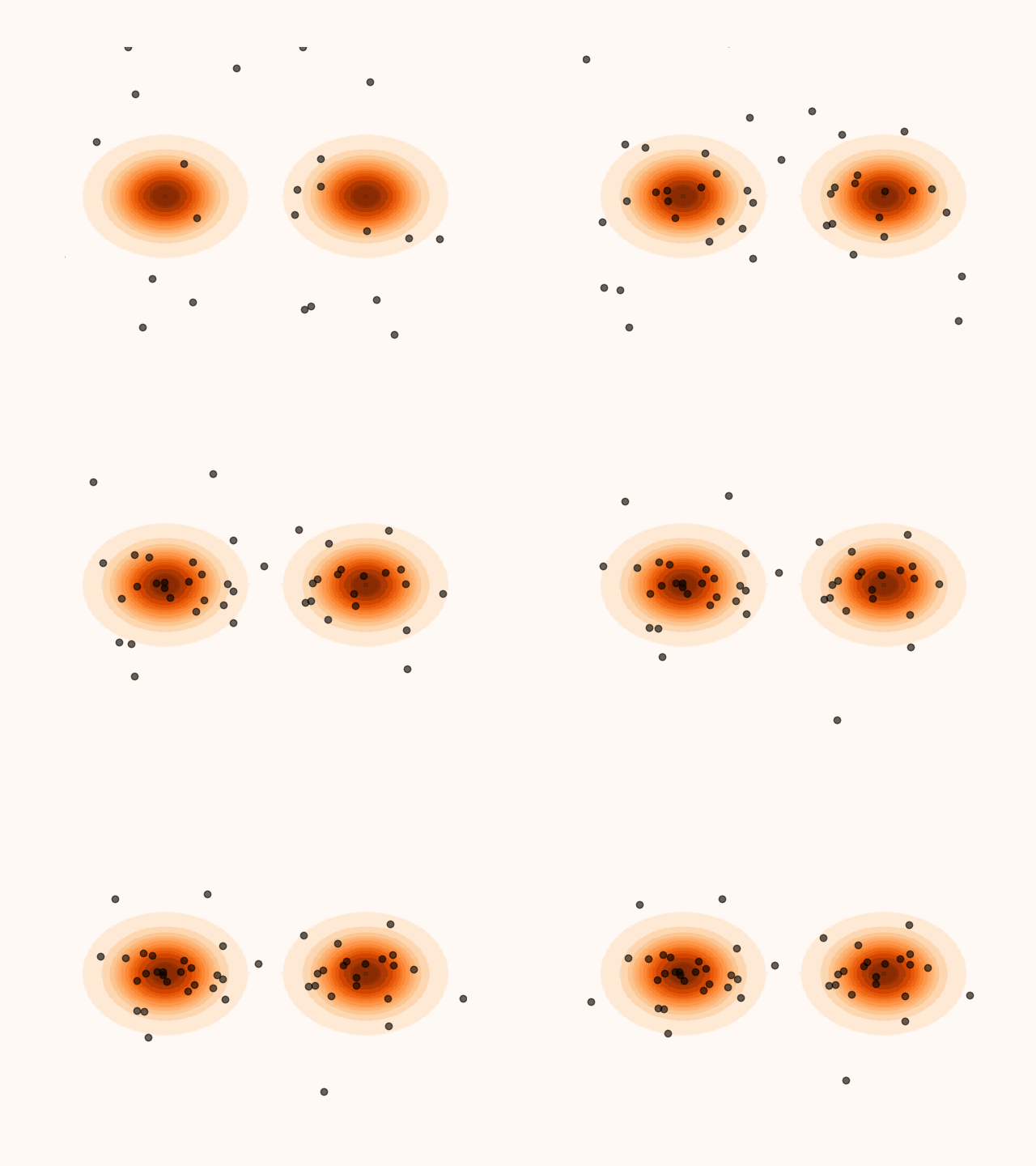
(b)Particle’s evolution with a pre-specified initial distribution.
Figure 4:Learning the initial distribution leads to faster convergence.
Code for Figure 4.
from svgd.sampler import SVGD
from svgd.distributions import TorchDistribution, Gaussian
from svgd.kernels import RBF
from svgd.kernels.parameters import ParameterKP
from svgd.lrs import StepLR
from svgd.callbacks import Logger

import torch
from torch.optim.adam import Adam
from torch.distributions import MixtureSameFamily, Categorical, Independent, Normal

from tqdm import tqdm
import matplotlib.pyplot as plt
from matplotlib.animation import FuncAnimation

from copy import deepcopy

torch.manual_seed(0)

device = "cuda:0"

n_epochs = 300
n_particles = 50
n_steps = 100

target_distribution = TorchDistribution(
    MixtureSameFamily(
        Categorical(torch.ones(2).to(device)),
        Independent(
            Normal(torch.tensor([[-1.0, 0.0], [1.0, 0.0]]).to(device), 1 / 3), 1
        ),
    )
)
initial_distribution = Gaussian(torch.zeros(2), torch.ones(2).mul(2.0)).to(device)
initial_distribution.mu.requires_grad_(False)
sigma = ParameterKP(torch.tensor(0.0), lambda x: x.exp()).to(device)
kernel = RBF(sigma)
lr = StepLR(
    torch.tensor(0.1),
    torch.tensor(n_steps / 2),
    torch.tensor(1e-9),
).to(device)
lr._log_decay_rate.requires_grad_(False)
lr._log_initial_lr.requires_grad_(False)
logger = Logger(log_x=True)
logger.activated = True
svgd = SVGD(
    target_distribution=target_distribution,
    initial_distribution=initial_distribution,
    kernel=kernel,
    lr=lr,
    bound_lr=True,
    ij_term_density=True,
    leaky_lr_clamp=True,
    callbacks=[logger],
).to(device)
svgd_fixed = deepcopy(svgd)
svgd_fixed.initial_distribution.requires_grad_(False)
logger_fixed: Logger = svgd_fixed.callbacks[0]
optimizer = Adam(svgd.parameters(), 1e-2)
optimizer_fixed = Adam(svgd_fixed.parameters(), 1e-2)


def optimize_svgd(svgd: SVGD, n_steps: int, optimizer: Adam):
    x, _, log_q = svgd.sample_with_log_q(n_particles=n_particles, n_steps=n_steps)
    log_q = log_q.mean()
    log_p = target_distribution.log_prob(x).mean()
    kld = log_q.sub(log_p)
    kld.backward()
    optimizer.step()
    optimizer.zero_grad()


for epoch in tqdm(range(n_epochs)):
    optimize_svgd(svgd, n_steps, optimizer)
    optimize_svgd(svgd_fixed, n_steps, optimizer_fixed)

grid = torch.arange(-2, 2, 0.01)
xg, yg = torch.meshgrid(grid, grid, indexing="ij")
grid = torch.cat((xg.reshape(-1)[:, None], yg.reshape(-1)[:, None]), dim=-1)
zg = target_distribution.log_prob(grid.to(device)).exp().view(xg.shape).cpu()

fig, ax = plt.subplots(1, 1, figsize=(6.4 * 1, 4.8 * 1))
ax.pcolormesh(xg, yg, zg, cmap="Oranges")
ax.set_xlim(-2.0, 2.0)
ax.set_ylim(-2.0, 2.0)
ax.axis("off")
scatter = ax.scatter([], [], color="black", alpha=0.6)


def animate(frame, logger):
    scatter.set_offsets(logger.x[frame])
    return (scatter,)


FuncAnimation(
    fig,
    lambda frame: animate(frame, logger),
    range(len(logger.x)),
    interval=1000 / 60,
    blit=False,
).save("particle_evolution_learnable_1.gif", fps=120)
FuncAnimation(
    fig,
    lambda frame: animate(frame, logger_fixed),
    range(len(logger.x)),
    interval=1000 / 60,
    blit=False,
).save("particle_evolution_learnable_2.gif", fps=120)
Stein Discrepancy as a Stopping Criterion
In SVGD, the number of iterations is a hyperparameter that must be tuned for each target distribution . MET-SVGD instead employs an adaptive number of steps by monitoring convergence at each iteration through the Stein discrepancy.
which measures the violation of Stein’s identity under the current particle distribution . By Stein’s identity, when , making it a natural convergence diagnostic. Moreover, computing incurs negligible additional cost since both and are already evaluated during the SVGD update.
Sampling is terminated once falls below a predefined threshold, yielding an adaptive number of transport steps that depends on the complexity of the target distribution.
Divergence Control via Metropolis-Hastings
In many application, the unnormalized density may exhibit abrupt gradient changes or contain highly non-smoothness regions, which can lead to instability or divergence during sampling.
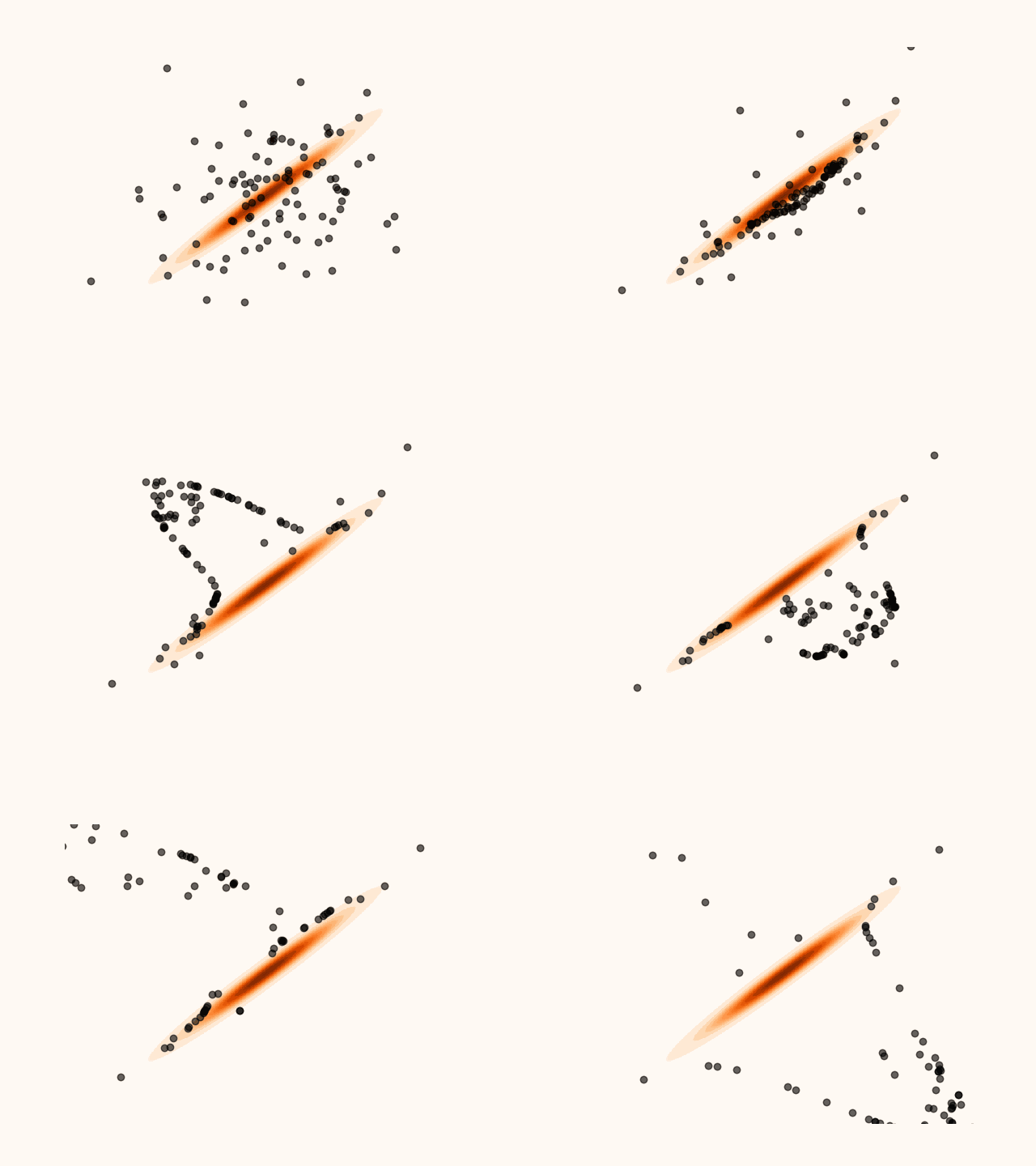
Figure 5:Particles’ evolution in the presence of non-smoothness.
Code for Figure 5.
from svgd.sampler import SVGD
from svgd.distributions import TorchDistribution
from svgd.kernels import RBF
from svgd.kernels.parameters import HeuristicKP
from svgd.lrs import ParameterLR
from svgd.callbacks import Logger

import torch
from torch.distributions import MultivariateNormal, Independent, Normal

import matplotlib.pyplot as plt
from matplotlib.animation import FuncAnimation

torch.manual_seed(0)

phi = torch.tensor(torch.pi / 4)
cos = torch.cos(phi)
sin = torch.sin(phi)
rotation = torch.tensor([[cos, -sin], [sin, cos]])
cov = torch.tensor([[1.0, 0.0], [0.0, 1e-2]])
cov = rotation @ cov @ rotation.T
target_distribution = TorchDistribution(MultivariateNormal(torch.zeros(2), cov))
initial_distribution = TorchDistribution(Independent(Normal(torch.zeros(2), 1.0), 1))
kernel = RBF(HeuristicKP("median"))
lr = ParameterLR(torch.tensor(0.1))
logger = Logger(log_x=True)
logger.activated = True
svgd = SVGD(
    target_distribution=target_distribution,
    initial_distribution=initial_distribution,
    kernel=kernel,
    lr=lr,
    callbacks=[logger],
)

n_particles = 100
n_steps = 25
x, _, _ = svgd.sample(n_particles=n_particles, n_steps=n_steps)
x = x.detach()

bound = 3.0

grid = torch.arange(-bound, bound, 0.01)
xg, yg = torch.meshgrid(grid, grid, indexing="ij")
grid = torch.cat((xg.reshape(-1)[:, None], yg.reshape(-1)[:, None]), dim=-1)
zg = target_distribution.log_prob(grid).exp().view(xg.shape)

fig, ax = plt.subplots()
ax.pcolormesh(xg, yg, zg, cmap="Oranges")
ax.set_xlim(-bound, bound)
ax.set_ylim(-bound, bound)
ax.axis("off")
scatter = ax.scatter([], [], color="black", alpha=0.6)


def animate(frame):
    scatter.set_offsets(logger.x[frame])
    return (scatter,)


animation = FuncAnimation(
    fig,
    animate,
    len(logger.x),
    interval=1000 / 60,
    blit=False,
)
animation.save("particle_evolution_non_smooth.gif", fps=120)
MET-SVGD addresses this issue by introducing a principled divergence control mechanism based on Metropolis-Hastings Tierney, 1994. At each step , the SVGD update is interpreted as a proposal distribution, yielding a proposed state . This proposal is accepted with probability , in which case . Otherwise, the proposal is rejected and the previous state is retained, i.e. .
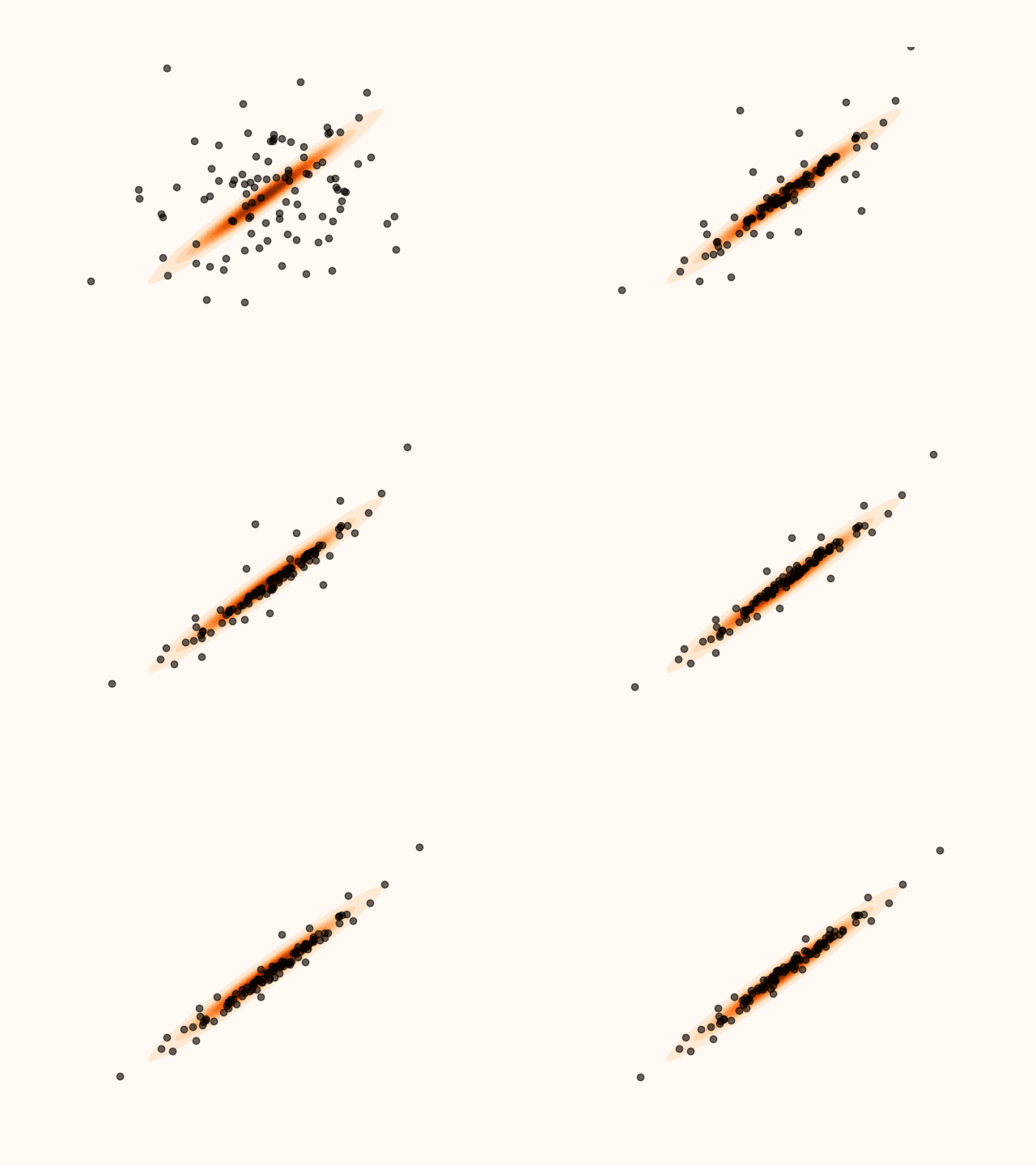
Figure 6:Particles’ evolution in the presence of non-smoothness with MH divergence control.
Code for Figure 6.
from svgd.sampler import SVGD
from svgd.distributions import TorchDistribution
from svgd.kernels import RBF
from svgd.kernels.parameters import HeuristicKP
from svgd.lrs import ParameterLR
from svgd.callbacks import Logger

import torch
from torch.distributions import MultivariateNormal, Independent, Normal

import matplotlib.pyplot as plt
from matplotlib.animation import FuncAnimation

torch.manual_seed(0)

phi = torch.tensor(torch.pi / 4)
cos = torch.cos(phi)
sin = torch.sin(phi)
rotation = torch.tensor([[cos, -sin], [sin, cos]])
cov = torch.tensor([[1.0, 0.0], [0.0, 1e-2]])
cov = rotation @ cov @ rotation.T
target_distribution = TorchDistribution(MultivariateNormal(torch.zeros(2), cov))
initial_distribution = TorchDistribution(Independent(Normal(torch.zeros(2), 1.0), 1))
kernel = RBF(HeuristicKP("median"))
lr = ParameterLR(torch.tensor(0.1))
logger = Logger(log_x=True)
logger.activated = True
svgd = SVGD(
    target_distribution=target_distribution,
    initial_distribution=initial_distribution,
    kernel=kernel,
    lr=lr,
    divergence_control="metropolis-hastings",
    callbacks=[logger],
)

n_particles = 100
n_steps = 25
x, _, _ = svgd.sample(n_particles=n_particles, n_steps=n_steps)
x = x.detach()

bound = 3.0

grid = torch.arange(-bound, bound, 0.01)
xg, yg = torch.meshgrid(grid, grid, indexing="ij")
grid = torch.cat((xg.reshape(-1)[:, None], yg.reshape(-1)[:, None]), dim=-1)
zg = target_distribution.log_prob(grid).exp().view(xg.shape)

fig, ax = plt.subplots()
ax.pcolormesh(xg, yg, zg, cmap="Oranges")
ax.set_xlim(-bound, bound)
ax.set_ylim(-bound, bound)
ax.axis("off")
scatter = ax.scatter([], [], color="black", alpha=0.6)


def animate(frame):
    scatter.set_offsets(logger.x[frame])
    return (scatter,)


animation = FuncAnimation(
    fig,
    animate,
    len(logger.x),
    interval=1000 / 60,
    blit=False,
)
animation.save("particle_evolution_non_smooth_mh.gif", fps=120)
For reversibility of the sampling chain, MET-SVGD augments the SVGD state with a simple auxiliary random variable that can take one of two values, or 1. At each step , is sampled at random and determines how the proposal is constructed. If the value is 1, the SVGD transformation is applied in the usual forward direction; if it is , the inverse SVGD transformation is applied. This construction allows MET-SVGD to inherit MH convergence guarantees while still leveraging the efficiency of SVGD.
When is a Rademacher random variable, the probability of acceptance is computed as:
With the inclusion of the MH correction, the induced distribution given becomes:
and is obtained via marginalization, with .
Given that MET-SVGD inherits the convergence guarantees of MH, converges to the target distribution as , independently of the number of particles . By contrast, existing convergence guarantees for SVGD in the literature require both Sun et al., 2023.
- Tierney, L. (1994). Markov Chains for Exploring Posterior Distributions. The Annals of Statistics.
- Sun, L., Karagulyan, A., & Richtarik, P. (2023). Convergence of Stein variational gradient descent under a weaker smoothness condition. AISTATS.